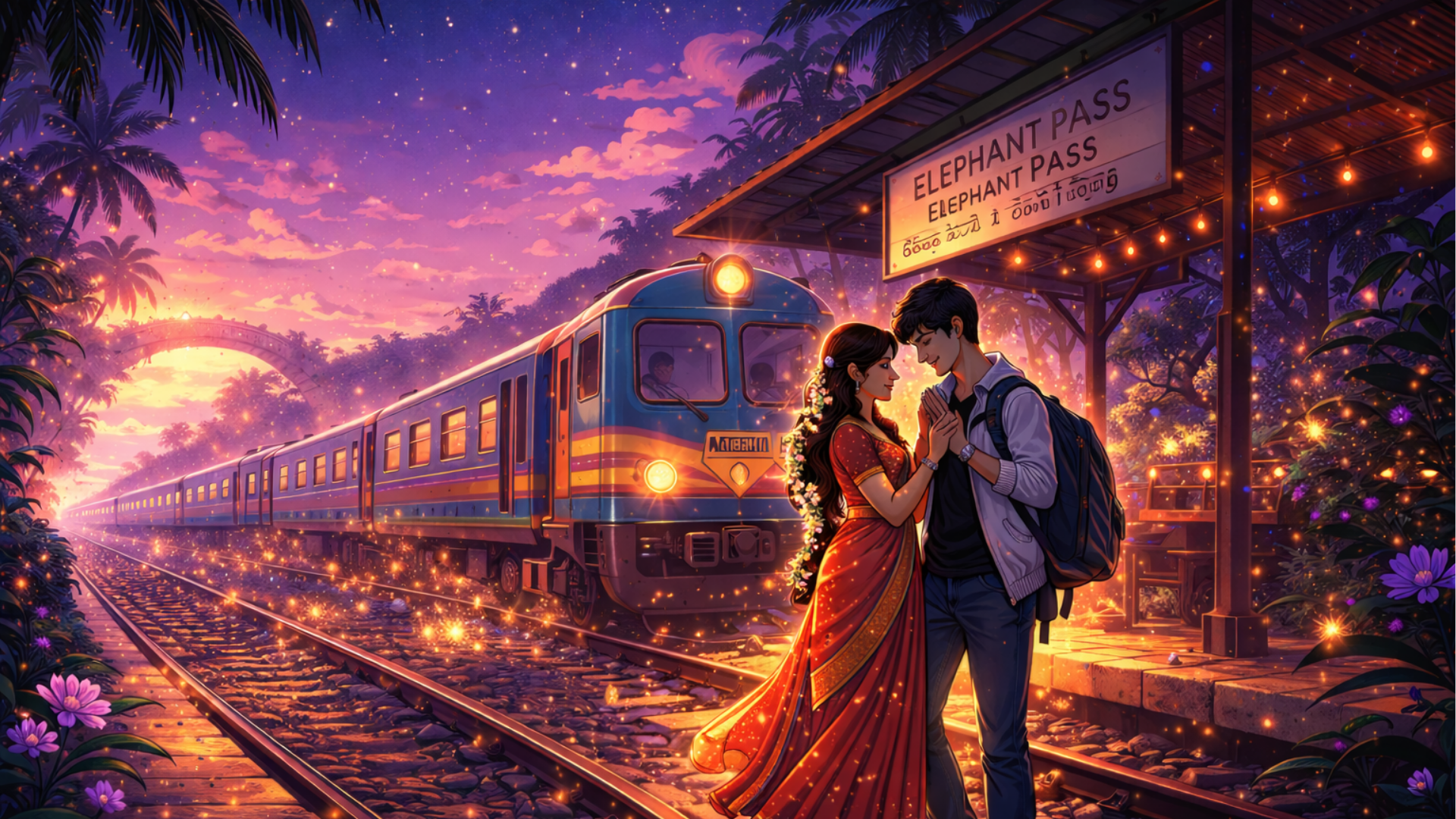
A magical moment frozen in time at the historic Elephant Pass station. Beneath a vibrant
purple sunset and surrounded by golden fireflies, a journey of love begins
Location
Sri Lanka
Time of Day
Dusk/Twilight
Camera
Fixed, No Movement
Style
Dreamy Anime
Final Result
A romantic twilight encounter at the historic station
The Original Song
A Sri Lankan train-romance anthem reimagined as a global dancehall hit
අලිමංකඩ (Alimankada) — Elephant Pass
This project is built around "අලිමංකඩ" by Shafraz ft Samitha
Mudunkotuwa — a beloved Sri Lankan hit that tells a playful, cinematic story of a chance
encounter on the Maradana-to-Jaffna train. The song's mix of Sinhala rap, romantic hooks, and a
bilingual love story across cultural lines makes it uniquely Sri Lankan. I reimagined it by translating
the streetwise narrative into punchy, rhythmic English while amplifying the train-journey energy into a
2026 Afro-Dancehall banger with chugging percussion loops, deep sub-bass, and a glossy pop finish.
From Sinhala rap anthem to Afro-Dancehall train-ride banger
Creative Process
The reimagination preserved the song's irresistible train-journey energy and playful romance while
transforming it across three layers: translating the narrative into punchy, rhythmic
English that captures the streetwise charm and bilingual flirtation, restructuring the
flow into a modern chorus-verse-bridge format with fast "ice-rap" male verses and breathy
melodic female sections, and reimagining the sonic palette from Sinhala pop-rap to a
2026 Afro-Dancehall production — continuous chugging train-track percussion, deep sub-bass, and
high-gloss pop synthesis with an infectious traveling vibe.
[Intro - Rhythmic train-track percussion
starts and builds]
(Chug-chug... yeah)
(Maradana to Jaffna... let's go)
(Music with synthesis style...)
[Chorus - The Running Hook - Fast and Rhythmic]
Travelled so far just to ask how you're doing
Watching the days and the love we were pursuing
You left on the train and you went away fast
Left me with a love that I wanted to last
At the Elephant Pass, yeah I'm waiting for you
Waiting for a soul that I thought I knew
(Yeah... still waiting for you)
[Verse 1 - Fast "Ice-Rap" Flow - Male]
I was sitting in Maradana, looking at the track
Heading to the North, never looking back
Feeling the vibe, yeah I'm catching a breeze
Then a girl hopped on, put my heart at unease
Asked for her story, she gave me a dance
I was playing it cool, I was taking a chance
Mixed up the Tamil, I gave her my heart
Right from the station, right from the start!
[Bridge 1 - Atmospheric Train Sounds & Heavy Bass Drop]
(The wheels are turning...)
(Jaffna bound...)
[Verse 2 - Melodic and Breathy - Female]
I don't wanna run, I don't wanna leave
In this crazy love, I still believe
No one by my side in the palmyra shade
Memories of us, they never fade
I'm lost in the fever, lost in the glow
Where did the love and the jasmine go?
I can smell your scent by the temple wall
Waiting for the rain, waiting for the fall.
[Verse 3 - Fast Modern Flow - Male]
Clock struck nine, just got on the ride
Saw a girl in white, nowhere to hide
Figure like a vision, scent like a rose
Stole my heart away, yeah heaven knows
"Hey, can I get your number?" I said with a grin
"Wanna hit Galle Face? Let the night begin."
"Do you understand me? Or you just confused?"
By the look in your eyes, I was highly amused!
[Chorus - Full Glossy Production - Duet]
Travelled so far just to ask how you're doing
Watching the days and the love we were pursuing
At the Elephant Pass, yeah I'm waiting for you
Waiting for a soul that I thought I knew!
[Instrumental Break - Extended Rhythmic Percussion & Bass]
(Keep it moving... keep the track hot)
[Outro - The Train Loop stays, fading slowly]
Elephant Pass...
Maradana to the North.
Wait for me.
(Chug-chug... chug-chug...)
[End on a Train Whistle Sound]
SUNO Pro — AI Music Prompt
2026 Afro-Dancehall, High-Gloss Pop, 102 BPM, Continuous Chugging Percussion Loop,
Deep Sub-Bass, Charismatic Male and Airy Female Vocals, Rhythmic Lyrical Flow, High-Fidelity Synthesis,
Traveling Vibe, Catchy and Infectious.
Project Overview
Capturing the poetry of departure and longing
Creative Vision
"Twilight at Elephant Pass" is a love letter to the romance of train travel and the bittersweet beauty
of departures. Set at the historic Elephant Pass railway station in northern Sri Lanka, the project
captures a fleeting moment between two lovers as a train—symbol of journey, separation, and
possibility—passes through their shared space. The fixed camera creates the feeling of witnessing a
private moment, while the dreamy anime aesthetic elevates the scene from documentary realism to poetic
reverie.
Cultural & Historical Context
Elephant Pass holds significant historical importance as a strategic location connecting the Jaffna
Peninsula to mainland Sri Lanka. The station name appears in Tamil and Sinhala, reflecting the
region's multilingual heritage. The choice of a traditional red-and-gold Tamil saree for the female
character honors Tamil cultural aesthetics while the modern casual clothing of the male character
represents contemporary Sri Lankan youth. This blend of traditional and modern, historical location
and timeless emotion, creates layered cultural authenticity within the fantasy framework.
Prompt Strategy: Dreamy Anime Aesthetic
The project employed a "Dreamy Anime" approach inspired by high-quality anime film backgrounds,
particularly the atmospheric mastery of studios like Makoto Shinkai's works. Specific location markers
("Elephant Pass," "Tamil and Sinhala text") grounded the fantasy in real geography while atmospheric
cues ("purple sunset," "golden fireflies," "soft bloom") created the dreamlike quality. This combination
ensures cultural specificity coexists with universal romantic themes.
Lighting Innovation: The refinement of the train's "bright headlight" to serve as a
secondary light source without washing out the purple sunset colors proved critical. This required
precise prompting to balance two competing light sources—natural twilight and artificial train
light—ensuring the warm orange glow enhanced rather than overwhelmed the purple-pink gradient sky.
The result creates dimensional lighting that feels both magical and physically plausible.
The Fixed Camera Philosophy
The deliberate choice of a completely fixed camera—no pans, zooms, shakes, or cuts—transforms the viewer
into a silent witness rather than active participant. This restraint creates contemplative space,
allowing the environmental animations (swaying plants, floating fireflies, passing train) to provide all
necessary movement. The stillness paradoxically intensifies emotional impact: we watch, unable to
intervene, as the train carries possibility through the frame and beyond, mirroring the helplessness of
watching loved ones depart.
Tools & Technology
The creative toolkit behind the twilight scene
Nano Banana Pro
Veo 3.1
Topaz Gigapixel
DaVinci Resolve
SUNO Pro
Canva
Scene Architecture
The elements that compose the twilight moment
Setting: Elephant Pass Station at Dusk
Visual Environment
The sky presents a dreamy gradient transitioning from purple at the zenith through pink to warm
orange near the horizon—the characteristic colors of tropical twilight. Tropical palm trees frame
the scene on both sides, their silhouettes creating natural compositional boundaries that focus
attention on the central subjects and railway track.
Station Signage
The station sign reads "ELEPHANT PASS" in English with Tamil (யானைக்காடு) and Sinhala (අලි ගමන)
text beneath, each script rendered with cultural accuracy. The sign glows softly under warm hanging
lights, creating a welcoming beacon in the deepening twilight. This multilingual signage
authentically represents the linguistic diversity of northern Sri Lanka.
Atmospheric Quality
The overall lighting scheme employs warm glowing illumination with soft bloom effects, creating the
painterly quality characteristic of high-end anime film backgrounds. The style draws inspiration
from modern digital illustration techniques while maintaining the smooth, looping-friendly motion
necessary for contemplative viewing.
The Couple: Foreground Characters
The Young Woman
She wears a traditional red-and-gold Tamil saree with authentic draping and patterning. The fabric
exhibits gentle wave motion in the breeze—subtle and elegant rather than exaggerated. Jasmine
flowers (மல்லிகை - mallikai in Tamil, a traditional choice for hair adornment) are woven into her
long hair, their white petals moving softly with natural air currents. The jasmine carries cultural
significance in Tamil tradition, symbolizing purity, love, and auspiciousness.
The Young Man
He wears modern casual clothing—likely jeans and a simple shirt—with a backpack slung over one
shoulder. This contemporary styling creates deliberate contrast with the woman's traditional attire,
suggesting generational change, cultural negotiation, or simply the everyday reality of young Sri
Lankans who move fluidly between tradition and modernity.
Character Animation Philosophy
Both characters exhibit very minimal, natural movements: slight breathing visible in torso motion,
small head tilts suggesting unspoken communication, gentle hand movements that convey restrained
emotion. Nothing is exaggerated or theatrical. This restraint emphasizes the contemplative mood—
these are two people caught in a significant moment, holding emotions carefully, aware that movement
might shatter the fragile magic of twilight.
Spatial Relationship
They stand close together beside the railway track, their proximity suggesting intimacy while their
stillness suggests uncertainty. The composition positions them as witnesses to the train's
passage—they are not boarding, merely watching possibility move past them, a visual metaphor for
choices not yet made or opportunities not yet seized.
Environmental Animation: The Living Atmosphere
Golden Fireflies
Firefly-like glowing particles float slowly through the air with organic, non-linear paths
Golden luminescence creates magical atmosphere without feeling artificial
Movement patterns suggest bioluminescent insects rather than digital effects
Provides gentle motion that draws the eye without distracting from central subjects
Natural Flora Movement
Small flowers and plants near the track sway gently with wind
Movement is subtle and rhythmic, suggesting soft breeze rather than strong wind
Adds life and organic texture to the lower portion of the frame
Reinforces the tropical setting through vegetation types and movement patterns
Sky Dynamics
Soft clouds pass slowly across the twilight sky in the background
Cloud movement is barely perceptible, creating sense of time passage without urgency
Maintains the dreamy quality while preventing static composition
Station Lighting
Ambient light flickers slightly from hanging station lamps
Flicker is subtle—suggesting realistic electrical light rather than fire
Creates warm pools of illumination that contrast with cooler twilight colors
Helps establish the threshold quality of the station: between day and night, arrival and
departure
Train Animation: The Moving Symbol
Visual Design
The train exhibits the colorful livery characteristic of Sri Lankan railways—likely featuring green,
red, and yellow color blocking with identifying numbers and text. The design authentically
represents the visual language of Sri Lankan rail transport while maintaining the painterly anime
aesthetic.
Movement Choreography
The train enters slowly from the left side of the frame, moving behind the couple rather than between
them and the camera. This positioning is crucial: it allows us to see the couple's reaction to the
train while the train itself provides background motion and symbolic weight. The wheels roll
smoothly
with realistic mechanics. Lights glow warmly from windows and headlight, creating moving pools of
illumination. The train passes fully through the scene and exits to the right, its departure
creating
narrative finality—the moment of possibility has arrived and now passes, whether seized or missed.
Symbolic Function
The train serves multiple metaphorical purposes: it represents journey and adventure, separation and
reunion, the passage of time, missed opportunities, or paths not taken. In South Asian romantic
contexts, trains carry particular resonance—countless love stories involve railway stations as sites
of dramatic departure or joyful reunion. The train's movement through the frame creates narrative
arc: before arrival (anticipation), during passage (confrontation with choice), after departure
(reflection or regret).
Depth Layer Enhancement
A second distant train silhouette appears faintly in the background later in the sequence, creating
atmospheric depth and suggesting the continuous flow of travel through this historic junction. This
layering reinforces Elephant Pass's identity as a crossroads, a place where journeys intersect
temporarily before diverging again.
Technical Specifications
Camera & Framing
16:9 cinematic aspect ratio
Fixed camera angle with no movement, panning, zooming, or shaking
Eye-level perspective placing viewer as witness to the scene
No cuts or edits within the sequence—single continuous shot
Motion Design
Smooth, looping-friendly animation suitable for extended contemplative viewing
Calm and hypnotic pacing that invites meditation rather than excitement
All movement serves emotional or atmospheric purpose rather than spectacle
Visual Style References
High-quality anime film backgrounds (particularly Makoto Shinkai's atmospheric work)
Modern digital illustration techniques with painterly qualities
Warm color grading emphasizing purple-pink-orange twilight palette
Soft bloom and glow effects creating dreamy, romantic atmosphere
The Captured Moment
Twilight magic at Elephant Pass station
Between Journey and Home
This definitive frame captures the essence of the entire project: two lovers stand together at the
threshold of possibility as twilight transforms the sky into a gradient of purple, pink, and warm
orange. The woman's traditional red-and-gold Tamil saree contrasts beautifully with the man's modern
casual attire, symbolizing the negotiation between tradition and contemporary life. Jasmine flowers
glow softly in her hair while golden fireflies drift through the air like wishes made visible. The
Elephant Pass station sign—trilingual testament to cultural diversity—glows warmly in the
background. Palm trees frame the scene while the railway track leads the eye toward the horizon,
suggesting journeys possible and paths untaken. The approaching train, with its warm headlight
cutting through the twilight, serves as both literal transportation and metaphorical catalyst—a
force that will either unite or separate these two figures. The fixed camera position transforms us
into silent witnesses to this private moment, unable to intervene, only to observe as beauty and
uncertainty coexist in perfect, fleeting balance.
Technical Insights & Reflections
Lessons from creating the twilight romance
Cultural Authenticity in Fantasy Contexts
One of the project's central challenges was maintaining cultural authenticity while working within a
"dreamy anime" aesthetic that could easily slip into generic fantasy. The solution involved specific
research-based details: accurate Tamil saree draping, appropriate jasmine flower placement in hair,
multilingual station signage with correct Tamil and Sinhala script, and authentic Sri Lankan train
livery. These precise cultural markers anchor the fantasy in real geography and tradition, allowing the
magical elements (golden fireflies, painterly twilight) to enhance rather than erase cultural identity.
Balancing Competing Light Sources
The technical refinement of the train's headlight demonstrates how small prompt adjustments create major
compositional improvements. Initial iterations had the headlight either too dim (losing its symbolic
power as beacon of possibility) or too bright (washing out the carefully crafted purple sunset colors).
The solution required prompting for "warm glow" rather than "bright light," specifying that the
headlight should "enhance without overwhelming" the twilight palette. This created dimensional lighting
where the train's artificial illumination and the natural twilight coexist, neither dominating—a visual
metaphor for the balance between human agency (the train, technology, journey) and natural beauty (the
sunset, the moment, stillness).
The Power of Restraint in Character Animation
The decision to limit character movement to "slight breathing, small head tilt, gentle hand movement"
rather than choreographed interactions proved essential to the contemplative mood. Excessive movement
would transform the scene from meditation into narrative, from witnessing into watching a performance.
The minimal animation keeps the characters real while preventing them from overwhelming the
environmental storytelling—the swaying plants, floating fireflies, passing train, and changing light all
carry as much emotional weight as the human figures.
Fixed Camera as Emotional Discipline
The completely static camera creates formal constraint that paradoxically increases emotional impact. By
refusing to zoom in for close-ups or pan to follow the train, the composition maintains respectful
distance from the subjects, allowing viewers to project their own experiences of departure, longing, and
possibility onto the scene. The camera's stillness also creates temporal ambiguity—this could be a
moment lasting seconds or stretched across minutes, frozen between decision and action.
Project Legacy: "Twilight at Elephant Pass" demonstrates that AI-generated content can
engage seriously with cultural specificity while maintaining universal emotional resonance. The project
proves that "anime aesthetic" need not mean cultural homogenization—rather, the painterly style can
enhance culturally grounded storytelling by elevating everyday moments into poetic reverie. The fixed
camera and minimal character animation show that restraint often communicates more than spectacle,
creating contemplative space where viewers complete the story themselves. Most significantly, the
project illustrates how locations carry narrative weight: Elephant Pass isn't just a scenic backdrop but
a historically significant junction whose very name suggests scale, migration, and the passage of great
forces. By honoring this specificity while crafting romantic fantasy, the work achieves emotional
authenticity that transcends cultural boundaries—anyone who has stood at a threshold between staying and
leaving, watching possibility approach and recede, will recognize this twilight moment as their own.